
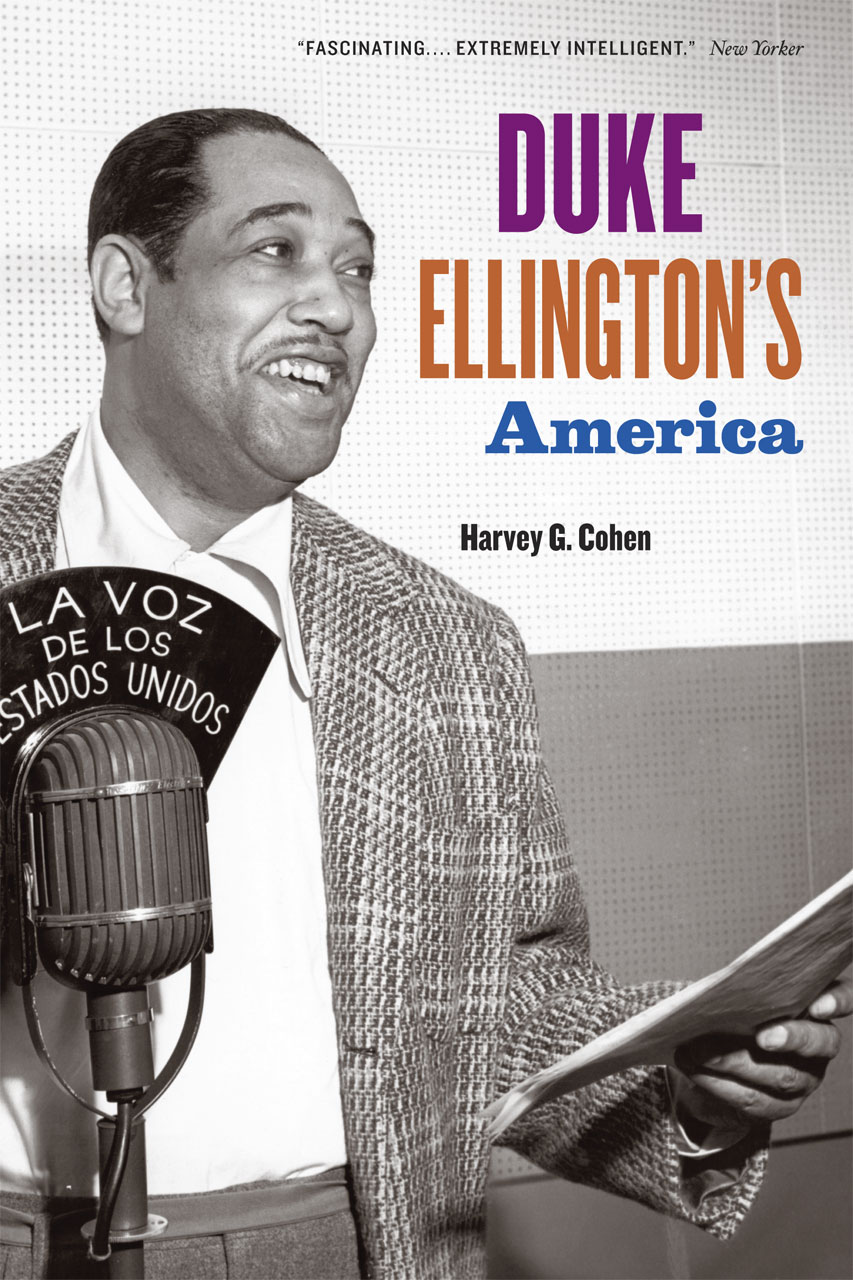
Duke Ellington in his own words from Duke Ellington’s America by Harvey Cohen 2010 University of Chicago Press
This book is filled with information that gives us context for a richer understanding of Ellington’s life and musical achievements. Here’s a straightforward review.
A couple of high points for me:
Cohen also gives us painful details about business hassles that repeatedly dragged down Ellington, even as he was creating masterpieces after masterpiece.
Over and over again the best parts of the book are Ellington’s own words – from correspondence, articles, and interviews. The simple statements at the top of this post appealed to me; If you read this book, you’re sure to find messages from Duke that are meant for you.
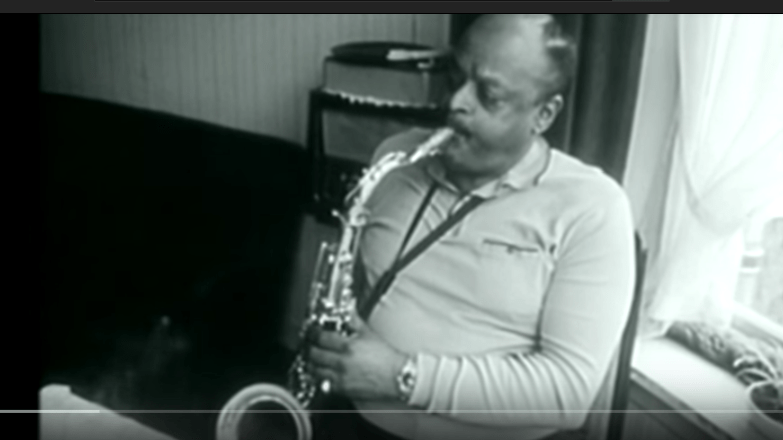
A priceless moment in the film “Big Ben: Ben Webster In Europe.” He demonstrates the old school strategy of playing along with a recording, in this case a Fats Waller LP.
This film isn’t a performance documentary; it’s sketches of Mr. Webster’s daily life: going to the zoo, talking with his landlady, playing some stride piano, commuting to gigs, running a rehearsal (with Don Byas!), and so forth.
Here’s a link to the full film
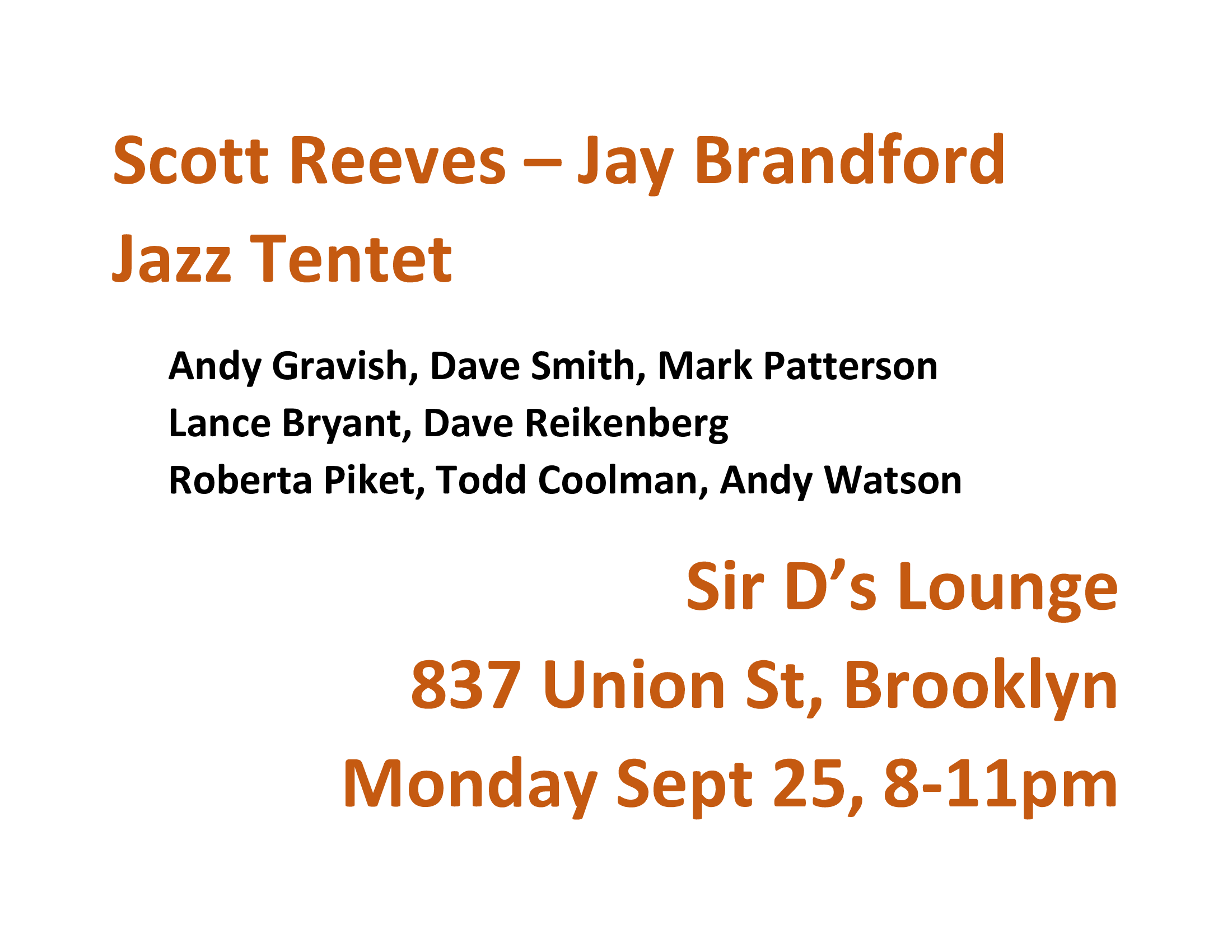
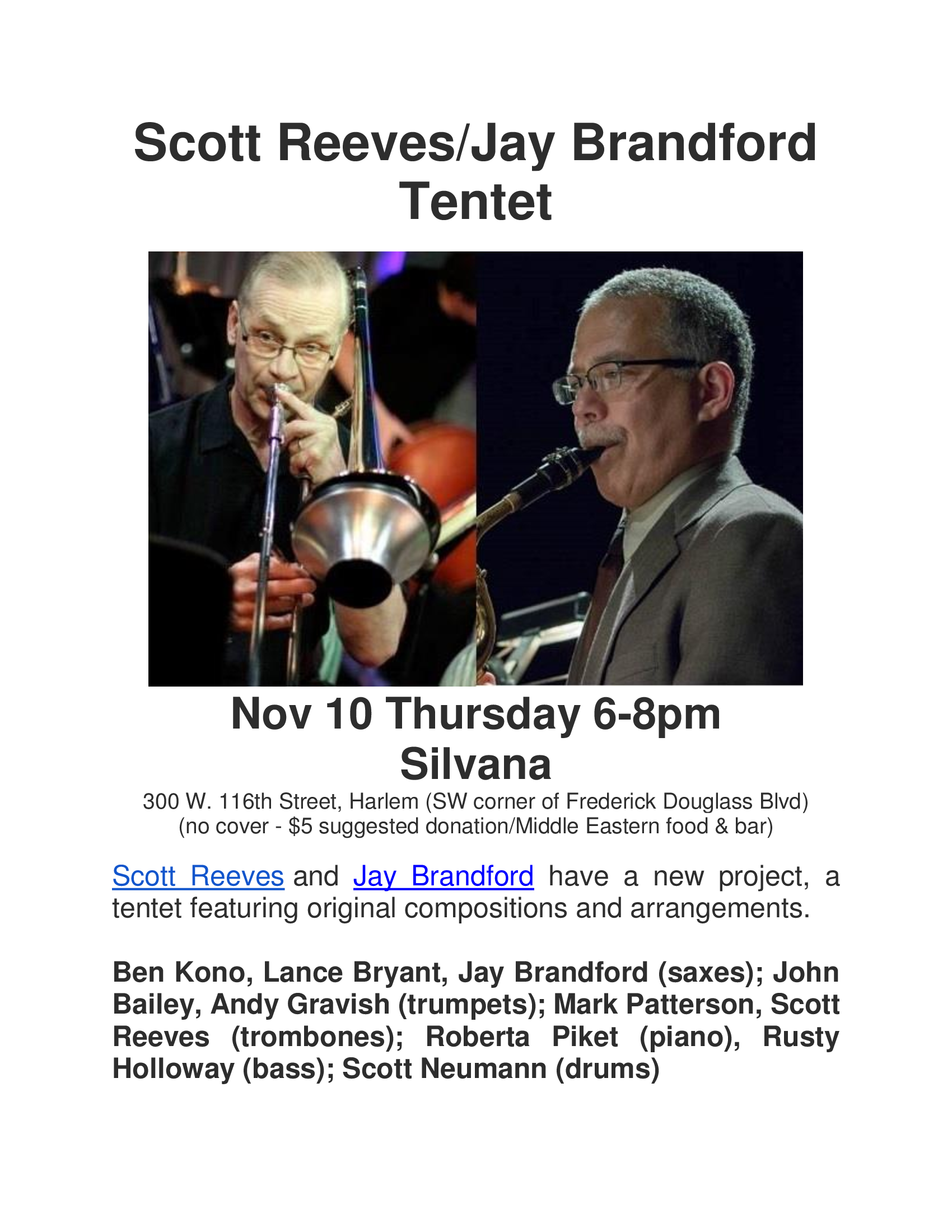

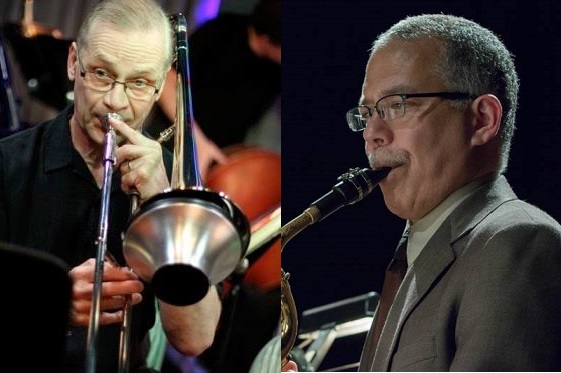
Scott Reeves and I have a new project together, a tentet featuring our original compositions and arrangements. Come on out to Sir D’s Lounge in Brooklyn and enjoy our music performed by Dave Pietro, Lance Bryant, Jay Brandford (saxes); John Bailey, Andy Gravish (trumpets); Mark Patterson, Scott Reeves (trombones); Roberta Piket (piano), Rusty Holloway (bass); Andy Watson (drums).
Sir D’s Lounge is at 837 Union Street, Brooklyn, in the same location as the old Tea Lounge in Park Slope. The club is presenting large ensemble jazz every Monday 8-11pm

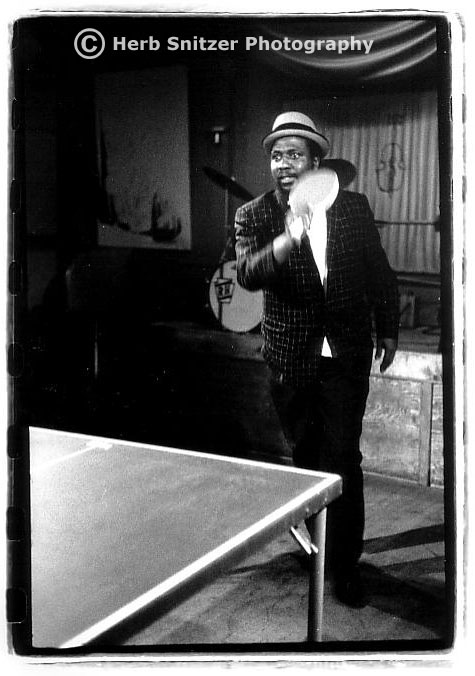
Interviewer: What other interests do you have?
Monk: Life in general.
Interviewer: What do you do about it?
Monk: Keep breathing.
from a 1971 interview
 Here’s a nice little tune from the 1960s that could use a little more attention. “Each Time I Think Of You” was co-composed by Duke Pearson and Donald Byrd, and was recorded at the May 1961 session for Blue Note Records that produced Byrd’s album, “The Cat Walk.”
The tune is a 40 bar medium-up swinger with A-B-C-A-D structure, a little unusual, with lovely bebop melodies throughout. It starts and ends in Ab major but modulates through B, A and C major along the way. This lead-sheet shows the 2-horn harmonies that Donald Byrd and Pepper Adams play, but listen to the recording to appreciate the supporting fills that Duke Pearson plays around the melody at the piano – they add so much to the personality of the song.
In Pepper Adams’ Joy Road, Gary Carner’s annotated discography of the baritone saxophonist, bassist Laymon Jackson recalls that drummer Philly Joe Jones was a last minute sub picked up on the way to Rudy Van Gelder’s recording studio. You’d never know it from the fantastic job he does catching all the right kicks to support the melody and the soloists. Pepper Adams takes 2 great choruses, followed by Byrd and Pearson with 1 each. The horn soloists then trade eights with Philly Joe, then it’s back to the head and out.
Here’s a concert-pitch PDF of Each Time I Think Of You. Hat tip to Mark Lopeman for his help with transcribing.
Here’s the recording.
Enjoy!

Louis Hayes and Peter Erskine
There’s a recording of a radio broadcast of Cannonball Adderley’s Sextet performing at the Five Spot in NYC in 1965 that I’ve been enjoying for a while. The band (Cannonball on alto, Nat Adderley on cornet, Charles Lloyd on tenor and flute, Joe Zawinul, Sam Jones, Louis Hayes on piano, bass, drums) is ON FIRE. They play their usual hits but also some material from their latest album, selections from the Broadway show, Fiddler On The Roof. I recently went back to it to listen specifically to Louis Hayes on drums, and I want to share one track with you.
But first, some background:
I’m checking out an ongoing dialog between Ethan Iverson, John Halle, Allen Chase and others based on an article written by Halle for Jacobin. My read of this conversation (and I only skimmed a lot of it) is that Halle finds the Jazz community’s politics to be superficial, so it’s no wonder many find Jazz to be culturally irrelevant. One specific battleground for this argument is Joe Henderson’s 1967 recording of “Without A Song.” Halle chides Henderson for playing a song that has such awful, racist lyrics, and posits that this choice undermines Henderson’s political statements from the same era such as his albums “Power To The People” and “If You’re Not Part Of The Solution You’re Part Of The Problem.” In response, Iverson eloquently describes the multidimensional, kaleidoscopic issues and feelings that a Hard Bop tenor player might process when choosing a standard to play in the year 1967: politics, melody, Trane’s death, alternate changes, Billy Eckstine, alternate lyrics, beauty, simplicity, contrast, nostalgia, record sales, and so much else!
Let’s leave that whole hairy topic alone for now and get back to Louis Hayes. In his description of Joe’s “Without A Song” Iverson gives the drummer a strong but qualified compliment: ” Mr. Hayes is one of the greatest bebop and hard-bop drummers, but no one thinks his major virtue is flexibility. [On this track] Hayes plays like a man possessed! For me it is Hayes’s best performance on the album.”
So this got me thinking. Perhaps Hayes didn’t choose to challenge himself by playing on the freer, avant-garde gigs that were blossoming in Jazz at that time, but certainly there are other ways of demonstrating flexibility and imagination in music. So here’s an example of just that, Hayes playing a little outside of the Hard Bop comfort zone on the Adderley Sextet’s live version of Jerry Bock’s “Chavalah” from the Broadway show Fiddler On The Roof. It’s a Joe Zawinul arrangement, a 6/4 bolero, that essentially just repeats the melody 5 times. No improvised solos, minimal original composition, just Louis Hayes building the groove over the course of four 10 measure phrases, then pulling it back to let us down gently on the 5th repeat. Of course Zawinul’s orchestration for the sextet is brilliant but I’m hearing Hayes’ flexible, imaginative groove as the absolutely essential ingredient that makes this performance work so well. Enjoy!
 Jay Brandford